
Memorizing and Reciting Surah Yaseen: Your Step-by-Step Guide to Mastery
For centuries, Surah Yaseen has been cherished as the “Heart of the Quran.” Its verses hold a powerful rhythm that comforts the soul, strengthens faith, and brings immense peace when recited.
However, many of us struggle to take the next step: transitioning from simply reading it to truly memorizing it, pronouncing its letters correctly (Tajweed), and connecting deeply with its rhythm.
Whether you are starting from scratch or looking to perfect your recitation, this guide is your roadmap. We have broken this journey down into three simple phases: listening to the masters, avoiding common pronunciation slips, and a practical 30-day memorization schedule.
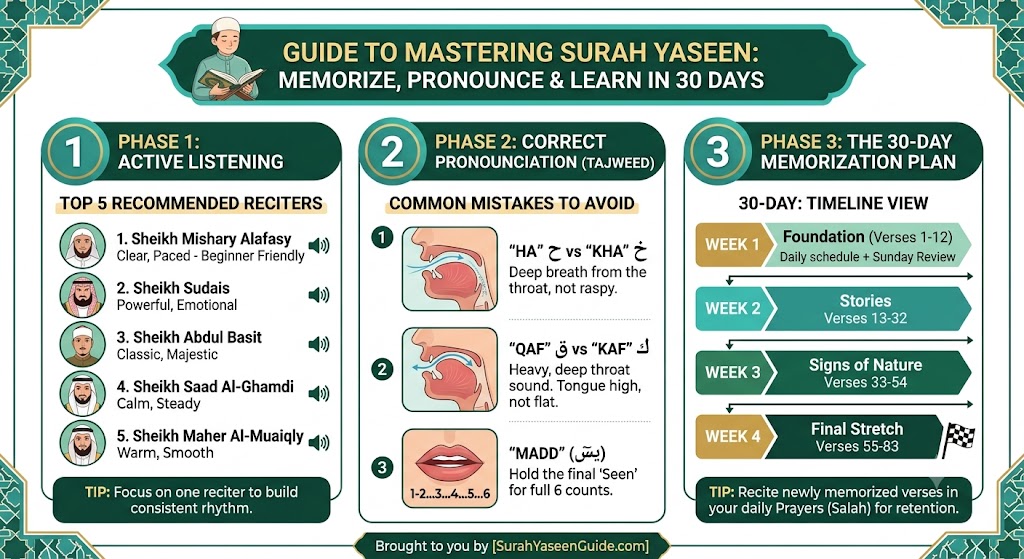
Phase 1: Listen to the Masters (Top Reciters)
Active listening is the secret weapon of memorization. By listening to a professional Qari (reciter), your brain naturally absorbs the rhythm, the proper stops, and the correct pronunciation of tricky Arabic words.
Here are five world-renowned reciters of Surah Yaseen, each offering a unique vocal style to match your learning preference:
| Reciter | Recitation Style | Why It Helps Learners |
| Sheikh Mishary Rashid Alafasy | Melodic, clear, and perfectly paced. | Ideal for beginners. His pronunciation is distinct, making it easy to repeat after him. |
| Sheikh Abdul Rahman Al-Sudais | Powerful, emotional, and rhythmic. | Great for connecting with the spiritual gravity of the verses. |
| Sheikh Abdul Basit Abdus Samad | Classic, majestic, with incredible breath control. | Perfect for appreciating the timeless, traditional beauty of classical Arabic Tajweed. |
| Sheikh Saad Al-Ghamdi | Calm, steady, and meditative. | Excellent background recitation for memorization and quiet reflection. |
| Sheikh Maher Al-Muaiqly | Warm, smooth, and deeply comforting. | Easy to follow along with during daily commutes or quiet evening sessions. |
Pro Tip: Pick one reciter to listen to consistently during this process. Your brain will map their vocal patterns, making it much easier to memorize the verses in their specific tone.
Phase 2: Common Pronunciation Mistakes to Avoid
Surah Yaseen contains 83 verses, filled with deep meanings and precise Arabic phonetics. For non-native Arabic speakers, a few letters can be particularly challenging.
When practicing, pay close attention to these three common areas:
1. Mixing Up “Ha” (ح) and “Kha” (خ)
- The Issue: The soft, throat-clearing ح (as in Hakeem – verse 2) is often mispronounced as a hard English “H” or a raspy خ (Kha).
- The Fix: ح is a clean breathy sound produced deep from the middle of the throat. Practice saying Al-Hakeem (ٱلْحَكِيمِ) with a smooth, warm breath.
2. Flattening the “Qaf” (ق) into a “Kaf” (ك)
- The Issue: In verses like “Inna Ja’alna fee a’naaqihim” (verse 8), the letter ق (Qaf) is often flattened into a light English “K” sound (ك).
- The Fix: ق is a heavy, deep-throat letter. It requires raising the back of your tongue against the roof of your mouth to create a deep, echoing “Q” sound rather than a sharp, flat “K”.
3. Rushing the Madd (Stretch) Signs
- The Issue: The opening verse “Ya-Seen” (يسٓ) features a long wave symbol (Madd) over the Seen. Many people say this too quickly.
- The Fix: The Yaa is stretched for 2 counts, but the Seen must be stretched for a full 6 counts (e.g., Yaa-Seeeeeeeen). Give the opening of the Surah its full weight!
Phase 3: The 30-Day Memorization Plan
Memorizing all 83 verses might feel overwhelming, but when broken down into small, daily bite-sized pieces, it becomes incredibly manageable.
Below is a systematic schedule designed for busy lives. By memorizing just 2 to 3 verses a day and dedicating weekends to revision, you will have the entire Surah memorized in one month.
1.Week 1: The Foundation:Verses 1 to 12.
- Mon–Fri: Memorize 2 verses per day. (e.g., Monday: Verses 1-2, Tuesday: Verses 3-4).
- Saturday: Group all 10 verses together and recite them while looking at the Quran.
- Sunday: Recite Verses 1–12 completely from memory during your daily prayers (Salah).
2.Week 2: The Stories of the Past:Verses 13 to 32.
- Mon–Fri: Memorize 4 verses per day (these verses are shorter narrative structures, making them easier to group).
- Saturday: Review and connect Week 2’s new verses.
- Sunday: The Bridge: Recite from Verse 1 all the way to Verse 32 without looking.
3.Week 3: Signs of Allah in Nature:Verses 33 to 54.
- Mon–Fri: Memorize 4 verses per day.
- Saturday: Consolidate this section. These verses focus on the sun, moon, and earth, so use the vivid imagery to help your memory.
- Sunday: Recite from Verse 1 to Verse 54.
4.Week 4: The Final Stretch:Verses 55 to 83.
- Mon–Fri: Memorize 5 verses per day to reach the finish line.
- Saturday: Clean up any tricky spots in the final verses, especially the powerful concluding verses (81–83).
- Sunday: Final Review. Recite the entire Surah from memory.
3 Quick Tips for Success
- Recite in your Prayers: The easiest way to lock a newly memorized verse into your long-term memory is to recite it during your Fard (obligatory) or Sunnah prayers.
- Use the “Loop” Method: Play a single verse on repeat using a Quran app (like Quran.com or Ayah) while driving, doing chores, or walking. Listen to it 10 times before trying to say it yourself.
- Consistency over Quantity: It is far better to memorize 1 verse perfectly every day than to rush through 5 verses and forget them by next week.